 Add to Chrome
 Add to Firefox
 Add to Edge
Conformal Thinking: Risk Control for Reasoning on a Compute Budget
Feb 03, 2026
Reasoning Large Language Models (LLMs) enable test-time scaling, with dataset-level accuracy improving as the token budget increases, motivating adaptive reasoning -- spending tokens when they improve reliability and stopping early when additional computation is unlikely to help. However, setting the token budget, as well as the threshold for adaptive reasoning, is a practical challenge that entails a fundamental risk-accuracy trade-off. We re-frame the budget setting problem as risk control, limiting the error rate while minimizing compute. Our framework introduces an upper threshold that stops reasoning when the model is confident (risking incorrect output) and a novel parametric lower threshold that preemptively stops unsolvable instances (risking premature stoppage). Given a target risk and a validation set, we use distribution-free risk control to optimally specify these stopping mechanisms. For scenarios with multiple budget controlling criteria, we incorporate an efficiency loss to select the most computationally efficient exiting mechanism. Empirical results across diverse reasoning tasks and models demonstrate the effectiveness of our risk control approach, demonstrating computational efficiency gains from the lower threshold and ensemble stopping mechanisms while adhering to the user-specified risk target.

Residual Context Diffusion Language Models
Jan 30, 2026Diffusion Large Language Models (dLLMs) have emerged as a promising alternative to purely autoregressive language models because they can decode multiple tokens in parallel. However, state-of-the-art block-wise dLLMs rely on a "remasking" mechanism that decodes only the most confident tokens and discards the rest, effectively wasting computation. We demonstrate that recycling computation from the discarded tokens is beneficial, as these tokens retain contextual information useful for subsequent decoding iterations. In light of this, we propose Residual Context Diffusion (RCD), a module that converts these discarded token representations into contextual residuals and injects them back for the next denoising step. RCD uses a decoupled two-stage training pipeline to bypass the memory bottlenecks associated with backpropagation. We validate our method on both long CoT reasoning (SDAR) and short CoT instruction following (LLaDA) models. We demonstrate that a standard dLLM can be efficiently converted to the RCD paradigm with merely ~1 billion tokens. RCD consistently improves frontier dLLMs by 5-10 points in accuracy with minimal extra computation overhead across a wide range of benchmarks. Notably, on the most challenging AIME tasks, RCD nearly doubles baseline accuracy and attains up to 4-5x fewer denoising steps at equivalent accuracy levels.
MemoryLLM: Plug-n-Play Interpretable Feed-Forward Memory for Transformers
Jan 30, 2026Understanding how transformer components operate in LLMs is important, as it is at the core of recent technological advances in artificial intelligence. In this work, we revisit the challenges associated with interpretability of feed-forward modules (FFNs) and propose MemoryLLM, which aims to decouple FFNs from self-attention and enables us to study the decoupled FFNs as context-free token-wise neural retrieval memory. In detail, we investigate how input tokens access memory locations within FFN parameters and the importance of FFN memory across different downstream tasks. MemoryLLM achieves context-free FFNs by training them in isolation from self-attention directly using the token embeddings. This approach allows FFNs to be pre-computed as token-wise lookups (ToLs), enabling on-demand transfer between VRAM and storage, additionally enhancing inference efficiency. We also introduce Flex-MemoryLLM, positioning it between a conventional transformer design and MemoryLLM. This architecture bridges the performance gap caused by training FFNs with context-free token-wise embeddings.
Your LLM Knows the Future: Uncovering Its Multi-Token Prediction Potential
Jul 16, 2025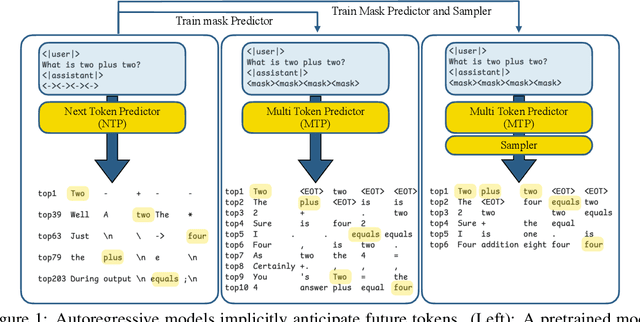
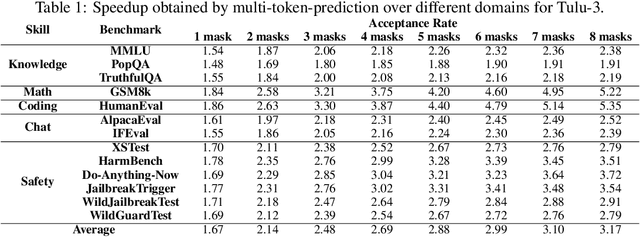
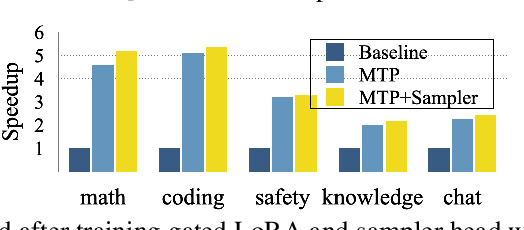
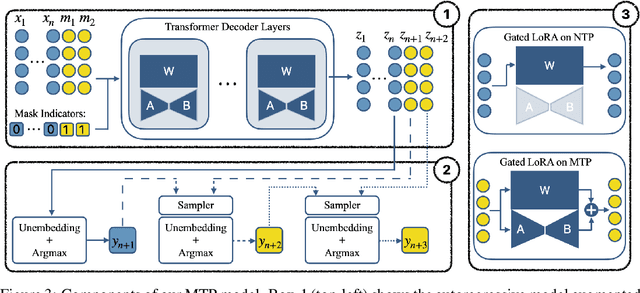
Autoregressive language models are constrained by their inherently sequential nature, generating one token at a time. This paradigm limits inference speed and parallelism, especially during later stages of generation when the direction and semantics of text are relatively certain. In this work, we propose a novel framework that leverages the inherent knowledge of vanilla autoregressive language models about future tokens, combining techniques to realize this potential and enable simultaneous prediction of multiple subsequent tokens. Our approach introduces several key innovations: (1) a masked-input formulation where multiple future tokens are jointly predicted from a common prefix; (2) a gated LoRA formulation that preserves the original LLM's functionality, while equipping it for multi-token prediction; (3) a lightweight, learnable sampler module that generates coherent sequences from the predicted future tokens; (4) a set of auxiliary training losses, including a consistency loss, to enhance the coherence and accuracy of jointly generated tokens; and (5) a speculative generation strategy that expands tokens quadratically in the future while maintaining high fidelity. Our method achieves significant speedups through supervised fine-tuning on pretrained models. For example, it generates code and math nearly 5x faster, and improves general chat and knowledge tasks by almost 2.5x. These gains come without any loss in quality.
The Illusion of Thinking: Understanding the Strengths and Limitations of Reasoning Models via the Lens of Problem Complexity
Jun 07, 2025Recent generations of language models have introduced Large Reasoning Models (LRMs) that generate detailed thinking processes before providing answers. While these models demonstrate improved performance on reasoning benchmarks, their fundamental capabilities, scaling properties, and limitations remain insufficiently understood. Current evaluations primarily focus on established math and coding benchmarks, emphasizing final answer accuracy. However, this evaluation paradigm often suffers from contamination and does not provide insights into the reasoning traces. In this work, we systematically investigate these gaps with the help of controllable puzzle environments that allow precise manipulation of complexity while maintaining consistent logical structures. This setup enables the analysis of not only final answers but also the internal reasoning traces, offering insights into how LRMs think. Through extensive experiments, we show that LRMs face a complete accuracy collapse beyond certain complexities. Moreover, they exhibit a counterintuitive scaling limit: their reasoning effort increases with problem complexity up to a point, then declines despite having remaining token budget. By comparing LRMs with their standard LLM counterparts under same inference compute, we identify three performance regimes: (1) low-complexity tasks where standard models outperform LRMs, (2) medium-complexity tasks where LRMs demonstrates advantage, and (3) high-complexity tasks where both models face complete collapse. We found that LRMs have limitations in exact computation: they fail to use explicit algorithms and reason inconsistently across scales. We also investigate the reasoning traces in more depth, studying the patterns of explored solutions and analyzing the models' computational behavior, shedding light on their strengths, limitations, and raising questions about their reasoning capabilities.
Proxy-FDA: Proxy-based Feature Distribution Alignment for Fine-tuning Vision Foundation Models without Forgetting
May 30, 2025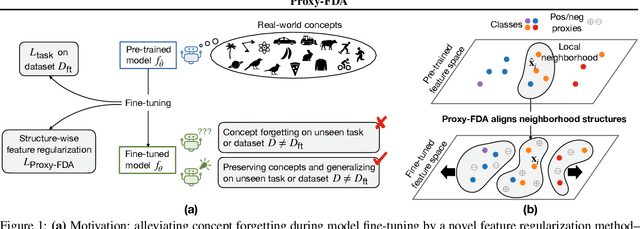
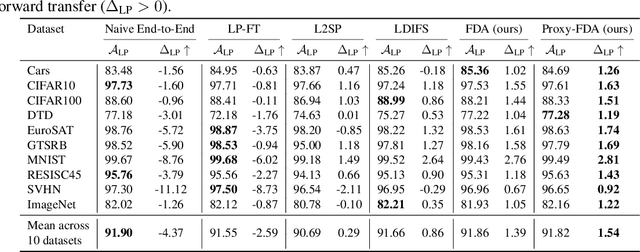
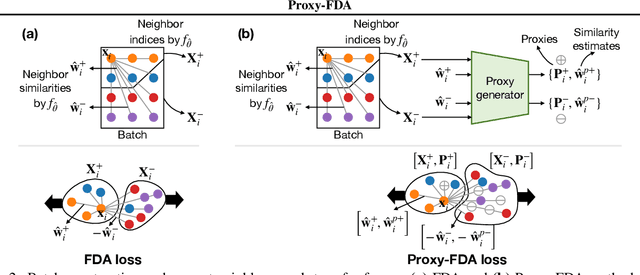
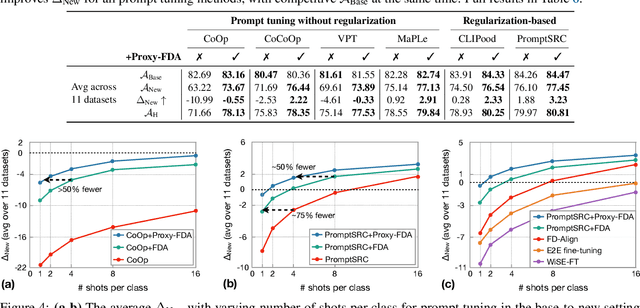
Vision foundation models pre-trained on massive data encode rich representations of real-world concepts, which can be adapted to downstream tasks by fine-tuning. However, fine-tuning foundation models on one task often leads to the issue of concept forgetting on other tasks. Recent methods of robust fine-tuning aim to mitigate forgetting of prior knowledge without affecting the fine-tuning performance. Knowledge is often preserved by matching the original and fine-tuned model weights or feature pairs. However, such point-wise matching can be too strong, without explicit awareness of the feature neighborhood structures that encode rich knowledge as well. We propose a novel regularization method Proxy-FDA that explicitly preserves the structural knowledge in feature space. Proxy-FDA performs Feature Distribution Alignment (using nearest neighbor graphs) between the pre-trained and fine-tuned feature spaces, and the alignment is further improved by informative proxies that are generated dynamically to increase data diversity. Experiments show that Proxy-FDA significantly reduces concept forgetting during fine-tuning, and we find a strong correlation between forgetting and a distributional distance metric (in comparison to L2 distance). We further demonstrate Proxy-FDA's benefits in various fine-tuning settings (end-to-end, few-shot and continual tuning) and across different tasks like image classification, captioning and VQA.
TiC-LM: A Web-Scale Benchmark for Time-Continual LLM Pretraining
Apr 02, 2025Large Language Models (LLMs) trained on historical web data inevitably become outdated. We investigate evaluation strategies and update methods for LLMs as new data becomes available. We introduce a web-scale dataset for time-continual pretraining of LLMs derived from 114 dumps of Common Crawl (CC) - orders of magnitude larger than previous continual language modeling benchmarks. We also design time-stratified evaluations across both general CC data and specific domains (Wikipedia, StackExchange, and code documentation) to assess how well various continual learning methods adapt to new data while retaining past knowledge. Our findings demonstrate that, on general CC data, autoregressive meta-schedules combined with a fixed-ratio replay of older data can achieve comparable held-out loss to re-training from scratch, while requiring significantly less computation (2.6x). However, the optimal balance between incorporating new data and replaying old data differs as replay is crucial to avoid forgetting on generic web data but less so on specific domains.
From Dense to Dynamic: Token-Difficulty Driven MoEfication of Pre-Trained LLMs
Feb 17, 2025Training large language models (LLMs) for different inference constraints is computationally expensive, limiting control over efficiency-accuracy trade-offs. Moreover, once trained, these models typically process tokens uniformly, regardless of their complexity, leading to static and inflexible behavior. In this paper, we introduce a post-training optimization framework, DynaMoE, that adapts a pre-trained dense LLM to a token-difficulty-driven Mixture-of-Experts model with minimal fine-tuning cost. This adaptation makes the model dynamic, with sensitivity control to customize the balance between efficiency and accuracy. DynaMoE features a token-difficulty-aware router that predicts the difficulty of tokens and directs them to the appropriate sub-networks or experts, enabling larger experts to handle more complex tokens and smaller experts to process simpler ones. Our experiments demonstrate that DynaMoE can generate a range of adaptive model variants of the existing trained LLM with a single fine-tuning step, utilizing only $10B$ tokens, a minimal cost compared to the base model's training. Each variant offers distinct trade-offs between accuracy and performance. Compared to the baseline post-training optimization framework, Flextron, our method achieves similar aggregated accuracy across downstream tasks, despite using only $\frac{1}{9}\text{th}$ of their fine-tuning cost.
SALSA: Soup-based Alignment Learning for Stronger Adaptation in RLHF
Nov 04, 2024


In Large Language Model (LLM) development, Reinforcement Learning from Human Feedback (RLHF) is crucial for aligning models with human values and preferences. RLHF traditionally relies on the Kullback-Leibler (KL) divergence between the current policy and a frozen initial policy as a reference, which is added as a penalty in policy optimization algorithms like Proximal Policy Optimization (PPO). While this constraint prevents models from deviating too far from the initial checkpoint, it limits exploration of the reward landscape, reducing the model's ability to discover higher-quality solutions. As a result, policy optimization is often trapped in a narrow region of the parameter space, leading to suboptimal alignment and performance. This paper presents SALSA (Soup-based Alignment Learning for Stronger Adaptation), a novel approach designed to overcome these limitations by creating a more flexible and better located reference model through weight-space averaging of two independent supervised fine-tuned (SFT) models. This model soup allows for larger deviation in KL divergence and exploring a promising region of the solution space without sacrificing stability. By leveraging this more robust reference model, SALSA fosters better exploration, achieving higher rewards and improving model robustness, out-of-distribution generalization, and performance. We validate the effectiveness of SALSA through extensive experiments on popular open models (Llama2-7B, Mistral-7B, and Gemma-2B) across various benchmarks (MT-Bench, Arena-Hard, UltraFeedback), where it consistently surpasses PPO by fostering deeper exploration and achieving superior alignment in LLMs.
Computational Bottlenecks of Training Small-scale Large Language Models
Oct 25, 2024
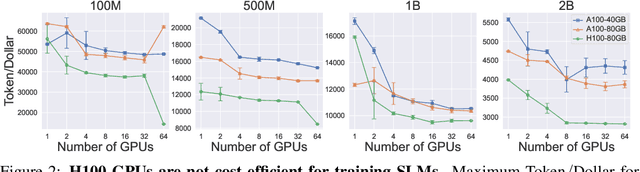
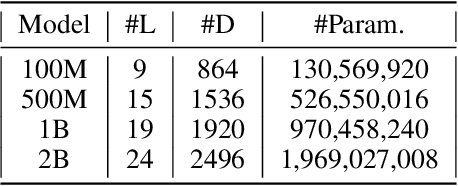

While large language models (LLMs) dominate the AI landscape, Small-scale large Language Models (SLMs) are gaining attention due to cost and efficiency demands from consumers. However, there is limited research on the training behavior and computational requirements of SLMs. In this study, we explore the computational bottlenecks of training SLMs (up to 2B parameters) by examining the effects of various hyperparameters and configurations, including GPU type, batch size, model size, communication protocol, attention type, and the number of GPUs. We assess these factors on popular cloud services using metrics such as loss per dollar and tokens per second. Our findings aim to support the broader adoption and optimization of language model training for low-resource AI research institutes.